
Software Refactoring and Modernization of Critical Systems
We transform your obsolete applications into modern, performant, and scalable platforms, without interrupting your business or losing your data.
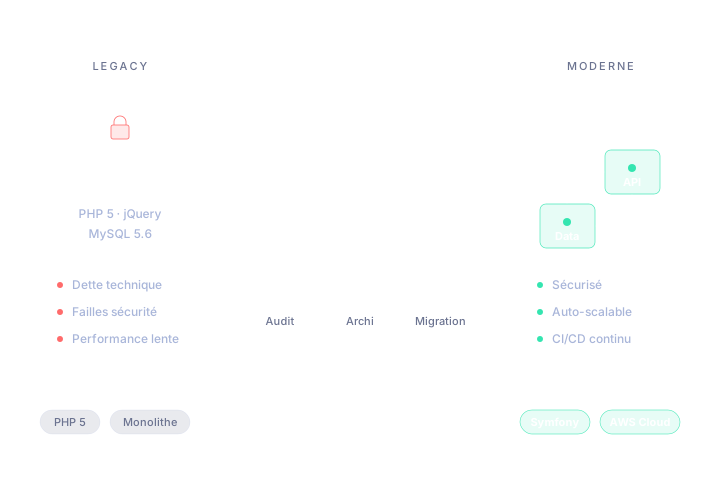
Should you redesign, modernize, or stabilize your application ?
We intervene when your application portfolio is hindering your growth to identify the right trajectory, not necessarily the most radical one.
Your technical stack is obsolete
Your framework is no longer maintained, libraries are no longer supported, security flaws are accumulating. Every month without modernization increases operational risk and prevents the addition of new features.
Technical debt paralyzes your progress
The code has become so tangled that every modification is slow, costly, and generates unexpected regressions. Your teams spend more time fixing than building.
Performance is plummeting
The application is lagging, can no longer support user load, and pages take several seconds to load. Your employees' productivity collapses, and the customer experience degrades.
The user experience is outdated
The interface is no longer adapted to modern usage (responsive, mobile, accessibility). Your employees bypass the tool, and your customers abandon their journeys.
Security risks are major
Unpatched flaws in your legacy system expose your critical data to cyberattacks and compromise your GDPR, ISO 27001, or industry compliance.
Maintenance costs are exploding
You spend the majority of your IT budget on corrective maintenance rather than innovation. Each fix costs more than the last.
The types of redesigns we conduct
From targeted refactoring to complete reconstruction, we adapt the strategy to the risk level and targeted business value
Total Redesign
Complete reconstruction of the application on a modern architecture (microservices, cloud-native, recent frameworks). Relevant when technical debt makes any evolution impossible and the business requires a clean break.
Security · Performance · DurabilityProgressive Redesign
Brick-by-brick modernization of the most critical modules via the Strangler Fig pattern. Limits risks, delivers value quickly, and preserves service continuity.
Agility · Controlled risk · ValueCloud & DevOps Migration
Transition from legacy on-premise hosting to a scalable cloud infrastructure (AWS, Google Cloud, Azure) with deployment automation (CI/CD, Infrastructure as Code, Docker / Kubernetes containerization).
Cloud · Scalability · DevOpsUX/UI Modernization
Visual and ergonomic redesign to simplify business processes, streamline user journeys, and improve tool adoption by your field teams.
Design · Productivity · UserThe technologies we modernize on
We work with proven frameworks, chosen for their maturity, community, and ability to last 10+ years.


You don't redesign an application by replicating the old one. Based on the audit of your application portfolio, we select the most relevant architecture according to your constraints regarding budget, continuity, and internal team.
Structural deliverables to drive the redesign
You keep total control over the evolution of your Information System.
Each sprint delivers a tested, documented component whose code belongs to you.
You are 100% owner of your modernized application.
We rebuild your solution on a healthy foundation, without vendor lock-in or technical lock-in.
At each step, you receive audited, documented code that complies with industry standards.
This guarantees a maintainable, scalable application built to last.
Technical audit & risk matrix
Comprehensive diagnosis of the existing system, mapping of technical debt, identification of bottlenecks, and quantified prioritization of tasks.
Target architecture & migration plan
Precise definition of the future stack, switchover sequencing, and schedule to ensure service continuity throughout the transition.
Documented API & non-regression testing
Guarantee that new components communicate perfectly with the existing IS and that critical functions are preserved throughout the redesign.
Certified data migration
Secure transfer of your historical databases to the new system via automated scripts, dry run phases, and total integrity validation.
100% proprietary source code
Full delivery of the source code, commented, documented, and transferable to any team, it's in the contract.
Why our clients entrust us with their application portfolio
No vague promises. Concrete, measurable, contractual commitments.
From audit to production in 4 steps
An iterative method to minimize risks and maximize value delivered at each sprint.
Audit & diagnosis
Code, process, and infrastructure analysis. Mapping of technical debt and definition of the redesign trajectory (value vs. risk).
2 - 4 weeksDesign & prototyping
Target architecture, stack selection, UX mockups, and functional prototypes to validate new journeys before development.
3 - 6 weeksIterative development
2-week sprints, regular demos, continuous integration. The product stabilizes progressively, and you test it under real conditions from the very first sprints.
2 - 6 monthsSwitchover & production release
Progressive or big bang deployment, final data migration, change management, user training, and post-launch TMA (Third-Party Application Maintenance).
ContinuousReady to eliminate your technical debt?
Don't let a legacy system dictate your roadmap. Free technical audit in 5 days.
The experts who modernize your application
Senior profiles, specialized in critical systems and complex architectures



Our other expertise
Frequently asked questions about software redesign
How to estimate the cost of a redesign ?
The budget depends on the size of the IS, the complexity of the business, and the chosen strategy (total or progressive). The redesign of a critical module starts around €30,000, while a complete platform can exceed €150,000. A preliminary technical audit allows for precise scoping and costing.
What is the average timeframe to modernize a tool ?
A modernization MVP generally takes 3 to 5 months. For a total redesign of a complex IS, expect 6 to 12 months with regular deliveries. Progressive redesign allows production to start in a few months on priority modules.
Do we lose data during the migration ?
No. We secure the transfer via automated scripts, dry run phases on copies, and automated integrity checks. Historical data is 100% preserved, with rollback points at each critical step.
Why choose a progressive redesign rather than a total one ?
Progressive redesign allows for modernization without interrupting business activity by prioritizing components with the highest business value. It spreads out the investment, limits risks, and delivers value from the first sprints, unlike a “big bang” redesign which can take 12+ months before showing any benefit.
My current technical stack is very old, is it possible to modernize it ?
Yes. We regularly work on legacy systems: PHP 5, legacy Java, Symfony 1, Zend Framework, AS400, WinDev applications. We migrate them to modern architectures (Symfony, Laravel, Node.js, React) with a strategy adapted to your criticality level.
Do you provide support after the production release ?
Absolutely. We offer Third-Party Application Maintenance (TMA) contracts to guarantee the system’s longevity, security, evolutions, and compatibility with new versions of frameworks and infrastructure.